Showing posts with label How it is Affecting Our Eco System?. Show all posts

Wednesday, November 20, 2019

Urbanization

Human beings have become an increasingly powerful environmental force over the last 10,000 years. With the advent of agriculture 8,000 years ago, we began to change the land.  And with the industrial revolution, we began to affect our atmosphere. The recent increase in the world’s population has magnified the effects of our agricultural and economic activities. But the growth in the world population has masked what may be an even more important human-environmental interaction: While the world’s population is doubling, the world’s urban population is tripling. Within the next few years, more than half the world’s population will be living in urban areas.

The level and growth of urbanization differ considerably by region. Among developing countries, Latin American countries have the highest proportion of their population living in urban areas. But East and South Asia are likely to have the fastest growth rates in the next 30 years. Almost all of the future world population growth will be in towns and cities. Both the increase in and the redistribution of the earth’s population are likely to affect the natural systems of the earth and the interactions between the urban environments and populations.

Effects of Urbanization:


  • Biodiversity:


 As cities grow in number, spatial extent, and density, their environmental and ecological footprints increase. Urban expansion that takes place in forests, wetlands and agricultural systems leads to habitat clearing; degradation and fragmentation of the landscapes. Urban lifestyles, which tend to be consumptive, requiring great natural resources and generating increasing amounts of waste also lead to increased levels of air, water, and soil pollution.


  • Inequality Water:


 Approximately 97% of the earth’s water is stored in the oceans, and only a fraction of the remaining portion is usable freshwater. When precipitation falls over the land, it follows various routes. Some of it evaporates, returning to the atmosphere, some seeps into the ground, and the remainder becomes surface water, traveling to oceans and lakes by way of rivers and streams.


  • Air Pollution:


 Air pollution often plagues industrialized cities, particularly during their early development. Episodes of high levels of sulfurous smog killed or sickened thousands in Donora in 1948, as well as in London in 1952. Other cities— primarily in the industrialized regions of the United States and Europe—also suffered from notoriously bad air quality. These events were the result of very high emissions of sulfur dioxide, smoke, and other particles during stagnant, foggy weather conditions.


  • Diseases:


Urbanization has led to reduced physical activity and unhealthy nutrition. The World Health Organization predicts that by 2020, non-communicable diseases such as heart disease will account for 69 percent of all deaths in developing countries. Another urbanization-related threat is infectious diseases. Air travel carries bacteria and viruses from one country to the next. In addition, people relocating from rural areas are not immune to the same diseases as long-time city residents, which puts them at a greater risk of contracting a disease.


  • Development of slums:


 The cost of living in urban areas is very high. When this is combined with random and unexpected growth as well as unemployment, there is the spread of unlawful resident settlements represented by slums and squatters. The growth of slums and squatters in urban areas is even further exacerbated by fast-paced industrialization, lack of developed land for housing, a large influx of rural immigrants to the cities in search of a better life, and the elevated prices of land beyond the reach of the urban poor.

Saturday, November 16, 2019

On Humans

Overview

The impacts of climate change include warming temperatures, changes in precipitation, increases in the frequency or intensity of some extreme weather events, and rising sea levels. These impacts threaten our health by affecting the food we eat, the water we drink, the air we breathe, and the weather we experience.

What is the Greenhouse Effect?

For centuries, humans have been burning fossil fuels to power their lives. This process releases additional greenhouse gases into the atmosphere, trapping heat that would escape into space otherwise.
We’ve known for decades about the damage all that extra heat is doing to the Earth. Now, a recent UN-backed report on climate change highlights just how dangerous that process has been. The planet has already warmed 1 degree Celsius and temperatures could rise even more – significantly changing life as we know it.
We’re already seeing the first impacts of this crisis. But here’s the good news – we still have time to turn things around.

HERE ARE THREE WAYS THAT CLIMATE CHANGE IS ALREADY AFFECTING PEOPLE’S LIVES:

1- Health: 


Climate action is just what the doctor ordered. And we mean that quite literally. Medical professionals have increasingly been sounding the alarm about the risks and consequences of continually burning fossil fuels.

Here’s the problem. The same dirty fossil fuel emissions that contribute to the greenhouse effect can lead to respiratory diseases – such as asthma – in children and adults. And they can be quite dangerous. Air pollution kills an estimated 7 million people worldwide every year, according to the World Health Organization.


By trapping heat into our planet, carbon emissions also damage the human body and mind in other ways. We’ve all heard about the risks of heat strokes. But did you know that warmer temperatures are linked to a 2 percent increase in mental health issues such as stress, anxiety,

2- Home: 


There’s really no place like home. But for many living in coastal communities, sea-level rise could lead to an unwanted (and sudden) move.

As our globe warms, glaciers melt and ocean water expands, leading seas to rise about 7 to 8 inches on average since 1900 – about 3 inches of that since 1993. The added volume of water creeping up coastlines slowly swallows land and homes and fuels more flooding inland (to name just a few impacts).
For example, in the United States, from 2005 to 2015, the median annual number of flood days more than doubled on the East Coast between Florida and North Carolina, thanks in part to rising sea levels.

3- Food:

The world population is expected to grow to almost 10 billion by 2050. With 3.4 billion more mouths to feed, and the growing desire of the middle class for meat and dairy in developing countries, global demand for food could increase by between 59 and 98 percent. This means that agriculture around the world needs to step up production and increase yields. But scientists say that the impacts of climate change—higher temperatures, extreme weather, drought, increasing levels of carbon dioxide and sea level rise—threaten to decrease the quantity and jeopardize the quality of our food supplies.


A recent study of global vegetable and legume production concluded that if greenhouse gas emissions continue on their current trajectory, yields could fall by 35 percent by 2100 due to water scarcity and increased salinity and ozone.

“We’re most concerned about the sharply reduced yields,” said Peter de Menocal, Dean of Science at Columbia University and director of the Center for Climate and Life. “We already have trouble feeding the world and this additional impact on crop yields will impact the world’s poorest and amplify the rich/poor divide that already exists.”

But climate change will not only affect crops—it will also impact meat production, fisheries and other fundamental aspects of our food supply.

Tuesday, October 29, 2019

On Oceans.


Warmer conditions are having an effect on our planet. The world's surface air temperature warmed 0.6 ℃ (1.1℉) on average during the last century. This may not sound like very much change, but it is. Below are some effects of climate change that are happening today.

Climate warming is causing areas to be more prone to drought.

More Water and fewer Glaciers: 


Rising sea level is a threat to coastal communities, wetlands, and coral reefs. During the 20th century, sea level rose about 15 cm (6 inches). In part, this was because of melting glaciers. The water from the melted ice is added to streams and rivers and eventually makes its way to the ocean. Over the past 100 years mountain glaciers, Arctic glaciers, and Greenland's ice have decreased dramatically in size. Sea level rise is also happening because the water warms, it takes up more space, it expands larger. Models predict that sea level may rise as much as 59 cm (23 inches) during the 21st Century, four times the amount of sea-level rise we have seen in the past century.
  
Each year, the amount of sea ice that covers the Arctic Oceans grows in the winter and melts at its edges in the summer. But lately, warmer temperatures have caused more ice to melt in the summer and less ice to grow in winter. The summer thickness of sea ice is circulation as the temperature and density of water changes. It is also speeding up warming in the Arctic, with less ice, less sunlight is reflected out to space and more is absorbed by the water and the land.

Changing Climate Means Changing Weather:


Climate warming is causing changes to weather in different regions of the world. In particular, it is causing more extreme weather events than we have seen in the past. these extreme weather events can have impacts on human health, limiting access to clean drinking water, food, and shelter and taxing people's ability to cope with heat, drought or flood.


  • More rain and flooding: Warmer temperatures have led to more intense rainfall events in some areas. This can cause flooding - a risk to the environment and human health.
  • More extreme drought: Warmer temperatures cause more evaporation, turning water into vapor in the air, and causing drought in some areas of the world. Places prone to drought are expected to become even drier over the next century. 
  • Stronger Hurricanes: This may be true for tropical cyclones in other parts of the world. Scientists continue to study whether the climate is the cause.
  • Heat Waves: It is likely that heatwaves have become more common in more areas of the world.
According to computer models, more global warming is in our future. If we continue to emit as many, or more, greenhouse gases, this will cause much more warming during the 21st century then we saw in the 20th century. During the 21st century, various computer models predict average temperature will climb 1.8°-4.0℃(3.2°-7.2℉).

Wednesday, October 23, 2019

Rise in Temperature

In recent years, scientists have noted a rapid increase in average temperatures throughout the World. This has effects on each and every region of the world. According to a report from the National Resources Defense Council (NRDC) titled 'Killer Summer Heat,' the average temperature of the United States could rise by as many as 11 degrees Fahrenheit by the end of the 21st century. "The risks to public health are greatest when high temperatures mix with other weather conditions to cause what's known as an 'Excessive Heat Event,' or EHE," the report states. EHE days occur when the temperature, dew point temperature, cloud cover, wind speed, and surface atmospheric pressure create conditions dangerous enough to cause heat-related deaths.
Data via NCDC. According to four major global meteorological and atmospheric monitoring agencies, temperatures have gradually risen for the past 30 years; the 2000s have officially been declared the warmest decade in recorded history.


Extensive Rise in temperature has vast effects on probably every part of this atmosphere some of those are discussed earlier in the BLOG while some we will discuss later in BLOG but here right now we will have a brief look on the effects of Rising in Temperature on  human lives how they are getting killed by this cruel environment?
This shows the Global Rise in Temperature from 1970 to 2015.
 The most common causes of death related to rising temperatures include the following conditions:
  • Heat exhaustion: According to The Mayo Clinic, heat exhaustion is characterized by profuse sweating and a rapid pulse/heartbeat; these two symptoms essentially indicate the body is overheating. Other signs of heat exhaustion include dizziness, low blood pressure, and muscle cramps. Individuals who suspect they have heat exhaustion should immediately stop whatever they are doing, retreat to a relatively cool location, and consume cool water or electrolyte-filled sports drinks.

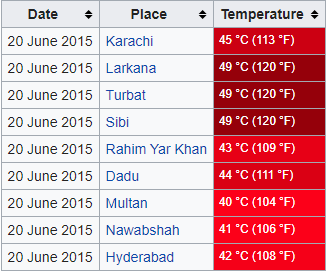
  • Heat Stroke: Heatstroke could be characterized as 'advanced heat exhaustion; the Mayo Clinic notes that individuals diagnosed with heat stroke usually have a temperature in excess of 104 degrees Fahrenheit. In addition to the outside temperature, the symptoms of heatstroke may be exacerbated by prescription medication, pre-existing medical conditions, high humidity and even consuming alcohol on a hot day. Unlike heat exhaustion, heatstroke demands medical attention; untreated heatstroke can negatively affect the brain, heart, kidneys, and muscles. In June 2015, a severe heatwave struck southern Pakistan mostly in its province of Sindh and its capital Karachi the highest temperature recorded in that heatwave was 49 °C(120 °F) causing the death of about 2000 people from dehydration and heatstroke. These events followed a separate heatwave in its neighboring country INDIA that killed 2500 people in May 2015.
    The Table shows recorded temperatures in Southern Pakistan in 2015.

  • Cardiovascular disease: According to the National Institute of  Environmental Health Science, extreme heat (as well as extreme cold) has been linked to a higher incidence rate of cardiovascular diseases and conditions, such as strokes and dysrhythmia. Cardiovascular disease is already the deadliest medical condition in the United States, and strokes are listed as the country's third leading cause of death.
  • Kidney disease: Prolonged exposure to excessively hot temperatures can lead to major kidney problems, notes American Family Physician contributor James L. Glazer MD. Rhabdomyolysis, a condition caused by damaged tissue, often results from heatstroke and has been linked to long-term renal disease. The body's ability to regulate water intake may also be affected, which can lead to kidney and/or bladder infections.
  • Aggravated allergies: Since two major allergens pollen and ragweed spread during relatively warm months; the EPA notes that spring allergy seasons are occurring earlier each year as a result of increasing temperatures.
In addition to the human toll, there is a significant financial impact to consider. 'Killer Summer Heat' discusses a heatwave that struck California in Summer 2006. Over the two-week period of extreme heat, 655 people lost their lives and more than 16,000 individuals made trips to the emergency room; the heatwave ultimately resulted in costs nearing $5.3 billion. The report notes that as many as 150,000 men, women, and children could potentially die of heat-related causes by the year 2100.

On Animals

Our climate is changing, both naturally and due to human exploitation. There is already undeniable evidence that animals, birds, and plants are being affected by climate change and global warming in both their distribution and behavior. Unless greenhouse gas emissions are severely reduced, climate change could cause a quarter of land animals, birdlife and plants to become extinct.
Climate variability and the change affect birdlife and animals in a number of ways; birds lay eggs earlier in the year than usual, plants bloom earlier and mammals are come out of hibernation sooner. Distribution of animals is also affected; with many species moving closer to the poles as a response to the rise in global temperatures. Birds are migrating and arriving at their nesting grounds earlier, and the nesting grounds that they are moving to are not as far away as they used to be and in some countries, the birds don’t even leave anymore, as the climate is suitable all year round.
A sea-level rise of only 50 cm could cause sea turtles to lose their nesting beaches - over 30% of Caribbean beaches are used by turtles during the nesting season and would be affected. The already endangered Mediterranean Monk Seals need beaches upon which to raise their pups and a rise in sea level could there could damage shallow coastal areas used annually by whales and dolphins which need shallow, gentle waters in order to rear their small calves.
Humans have already destroyed many of the natural migrations of animals.

The migratory journeys of Wildebeest in several African countries are stopped by fences. Changing rainfall patterns are causing dams to be erected in some areas of our planet, not taking into account the migratory fish and mammals that annually migrate upriver to breed and spawn and water birds that rely on wetland sites for migration are at threat from rising sea levels caused by human effects. On the other side of the coin, the atmosphere is sucking moisture from the land at a greater rate than ever before causing severe droughts in many countries which are now facing reduced crop production and major drinking water shortages.
Although it is thought that no species has yet become extinct exclusively because of climate change, many migratory and non-migratory species are expected to become extinct in the near future.

Monday, October 14, 2019

Ozone Depletion.

Ozone Layer is a protective layer or shield around the earth which covers the earth from the harmful Ultra Violet Rays of Sun. It is also a very significant part of the earth's second atmospheric layer known as the stratosphere. It is found in the lower part of the Stratosphere at a height of 15 to 35 km. Going back in its history it was discovered by the French physicist Charles Fabry and his partner Henri Buisson in the year 1913. It contains a high concentration of ozone molecules (O3). The very high concentration of ozone molecules here results in the absorption of high or medium frequency Ultra Violet Rays coming from SUN which otherwise would potentially raise health concerns.
Our understanding of ozone depletion is a result of laboratory studies, computer models, and atmospheric observations. The wide variety of chemical reactions that occur in the stratosphere have been discovered and studied in the laboratory. Chemical reactions between two gases follow well-defined physical rules. Some of these reactions occur on the surfaces of stratospheric clouds formed in the winter in the stratosphere. Reactions have been studied that involve many different molecules containing chlorine, bromine, fluorine, and iodine and other atmospheric constituents such as carbon, oxygen, nitrogen, and hydrogen. These studies have shown that several reactions involving chlorine and bromine directly or indirectly destroy ozone in the stratosphere. 
The main factors of Ozone Depletion or the causes behind Ozone Destruction are discussed here.


Causes:

  • Ozone Hole: Ozone hole is the primary cause of ozone depletion at higher levels. It is causing the ozone layer much damage that its consequences are being faced on each and every day. The Antarctic ozone hole is an area of the Antarctic stratosphere in which the ozone levels have dropped to as low as 33 percent of the values recorded in 1975. The ozone hole occurs during the Antarctic spring, starting from September to early weeks of  December, as strong western winds start to circulate around the continent and create an atmospheric container. Within this polar vortex, over 50 percent of the lower stratospheric ozone is destroyed during the Antarctic spring. The primary cause of ozone depletion is the presence of chlorine-containing source gases primarily Coloro Flouro Hydrocarbons. In the presence of UV light, these gases after dissociating release chlorine atoms, which then go on through the air to the stratosphere to where they destroy the ozone layer. The Cl-catalyzed ozone depletion can take place in the gas phase, but it is dramatically enhanced in the presence of polar stratospheric clouds (PSCs).

Effects of Ozone Depletion:

  1. Increased UV:  Since the ozone, layers are being destroyed by earth's gasses and it's bad atmosphere so the layer which prevents Ultra Violet rays from SUN reaching earth's surface is also being destroyed so this increase the amount of Ultra Violet Rays coming to earth form SUN. Which is quite a horrible thing and is surely not good for the earth's atmosphere.  In the Year 2008 October, the Ecuadorian Space Agency published a report called HIPERION. The study used ground instruments in Ecuador and the last 28 years data from 12 satellites of several countries, and found that the UV radiation reaching equatorial latitudes was far greater than expected, with the UV Index climbing as high as 24 in Quito; the WHO considers 11 as an extreme index and a great risk to health. The report concluded that the ozone depletion levels around the mid-latitudes of the planet are already endangering large populations in these areas. Later many countries use their own resources and published their studies which also resembles the studies that Ecuador published earlier.

  1. Biological Effects: The main effects ozone depletion is on humans and especially their health issues are raising at a high pace and this is probably the main and the only concern about ozone depletion at the moment. And this is the biggest challenge in battling climate change. The one major disease that is killing human beings is CANCER. Different forms of cancer are due to exposure to Ultra Violet Radiation and this disease is incurable. Ozone depletion would magnify all of the effects of UV on human health, both positive including the production of vitamin D and negative including sunburn, skin cancer, and cataracts. In addition, increased surface UV leads to increased tropospheric ozone, which is a health risk to humans.
  2. Effects On Animals: The depletion of ozone also has effects on Animals especially in the areas situated in antarctic or in its neighbors. Because in those areas they are directly exposed to the UV radiation coming from the Sun. In November 2011 scientists of Institute of Zoology of London published a report that says whales off the coast of California have shown a sharp rise in sun damage, and these scientists "fear that the thinning ozone layer is to blame" The study photographed and took skin biopsies from over 150 whales in the Gulf of California and found "widespread evidence of epidermal damage commonly associated with acute and severe sunburn", having cells that form when the DNA is damaged by UV radiation.
The Effects of Ozone Depletion is being seen by the scientist in every field of human life. This is a matter of concern for humans that we have to reduce our needs and minimize the usage of things that damages the OZONE layer and making holes in it. Because if we didn't think of it right now then it might be late.


Urbanization

Human beings have become an increasingly powerful environmental force over the last 10,000 years. With the advent of agriculture 8,000 year...