Showing posts with label WHAT IS CLIMATE CHANGE?. Show all posts

Wednesday, November 20, 2019

Negatives and positives of climate change.

Basic Idea:
                   Climate change is having a detectable effect on bird populations at a European scale, including both negative and positive effects.
                The number of bird species whose populations are observed to be negatively impacted by climatic change is three times larger than those observed to be positively affected by climate warming in this set of widespread European land birds.
           The Climatic Impact Indicator, which illustrates the impact of climate change on bird populations, has increased strongly in the past twenty years, coinciding with a period of rapid climatic warming in Europe. Potential links between changes in bird populations and ecosystem functioning and resilience are not well understood...

What are the negative (and positive) impacts of climate change on biodiversity?

1- Climate change impact indicator for birds:
The indicator demonstrates the impact of climate change on widespread bird populations has increased strongly in the past twenty years. The Climatic Impact Indicator measures the divergence between the population trends of bird species projected to expand their range and those predicted to shrink their range due to climate change.
2- Weighted population trend of species predicted to lose range in response to climatic change (90 Species):
The weighted population index of species expected to lose in range due to climatic change has decreased by 20% since 1989.
3- Weighted population index of species predicted to gain range in response to climatic change (30 species):
The weighted population index of species expected to gain in range due to climatic change has increased by over 30 % since 1989.


Monday, November 18, 2019

Pollution.

"Pollution is defined as the induction of harmful materials or chemical components to the natural environment." It can be natural or foreign occurring components. Pollution has been a part of human civilization from the very first day. But in today's world due to the rapidly growing Industrial Age, it is very difficult to stop it despite the fact that it is having bad effects on our environment.

There are many kinds of POLLUTION starting from Air to Land and water and many types of pollution. Pollution is something that is certainly not good for our environment and if we didn't take hard steps to stop it it's consequences would be dangerous in the future. It is a fact that in this industrial age we can't eradicate the pollution but we can minimize it by taking the best measures in this regard.

Types of Pollution:

  • Air Pollution: It is the type of pollution that is a result of harmful gasses that are being released by Industries and other sites. These gasses go on to mix with the air and pollute it the air than breath by Human's which causes health issues and significant damage to our environment. There are various locations, activities or factors which are responsible for releasing pollutants into the atmosphere. From which some are man-made while some are natural.

         Man-Made:

  1. Smoke coming from chimneys of industries which includes harmful gasses for the environment.
  2. The automobile industry is also the source of air pollution motor vehicles, marine vessels, and aircrafts all release toxic gasses like Lead Oxide and Carbon Monoxide which are known as silent killers.
  3. Fumes from paint, hair spray, varnish, aerosol sprays and other solvents.
  4. Army resources, such as nuclear weapons, toxic gasses, germ warfare, and rocketry. If you just look at this industry that how vastly or rapidly this industry is growing and every country wants to leave the other behind in making nuclear weapons.


        Natural:

  1. Dust is a primary source of air pollution which comes from natural sources, usually large areas of land with little vegetation or no vegetation
  2. Gasses are also causing environmental pollution Methane, emitted by the digestion of food by animals, for example, cattle.
  3. Radon gas within Earth's crusts. Radon is a colorless, naturally occurring, radioactive gas that is formed from the decay of radium element. It is considered a health hazard and extremely harmful for humans as well as the environment. Radon gas from natural sources can accumulate in buildings, especially in confined areas such as the basement and it is also known as the second most frequent cause of lung cancer, after cigarette smoking.
  4. Smoke which comes from burning of forests by natural methods also releases harmful gasses and the burning of forests is so frequent these days which is also a result of rising in earth's temperature which is causing the forests around the globe to burn at large.
  5. Excessive Volcanic eruption in the world also causing air pollution. Volcanoes are a mixture of gasses that are cooked at high temperatures in Earth's crust.

  • Noise Pollution: Noise pollution or sound pollution is one of the major factors that are polluting our environment. It is mostly in Urban Areas due to much noise of Big vehicles and also due to Industries especially in industrial areas it is causing the human hearing decibel level to drop at dangerous levels. Which can affect our listening abilities actually it is affecting our listening abilities.
  • Plastic Pollution: It is the accumulation of plastic objects and particles in  Earth's eco-system that negatively affects life on a large scale it includes every kind of life from wildlife to humans and marine life. Plastics that act as pollutants are categorized into micro or meso and macro pollutants, based on size. Plastics are inexpensive and durable, and as result levels of plastic production by humans are high which is real trouble because since human thinks that plastics are more beneficial to them and can reduce headache so the ignore it's negative effects on our environment. However, the chemical structure of most plastics renders them resistant to many natural processes of degradation and as a result, they are slow to degrade. Together, these two factors have led to a high prominence of plastic pollution in the environment. Which is certainly in the bad prospect of our environment and can be fatal in the future if continue ignoring this factor.

Sunday, October 27, 2019

Poor Waste Disposal.


Poor waste disposal is also the main reason behind climate change happening around us. But before starting our discussion we need to define what does mean by "WASTE" and the difference between "Proper Waste Management" and "Poor Waste Management/Disposal".
  1. Waste:  Waste is described as anything left after primary use or of no use at all. These are also termed as unwanted or unusable materials. In this era of modern civilization where humans require bulk amount of resources waste is emerging as a major environmental issue right in front of everyone but no one has the time to think about it or ponder on its solution. The world has a population of about 7.5 billion which means there is a bulk amount of waste left over each day and to dispose of it properly requires proper management and a separate system.
  2. Proper Waste Management: Waste management are the activities required to manage waste from its inception to its final disposal. This includes all kinds of management the collection, transport, treatment and disposal of waste, together with monitoring and regulation of the waste management process. Waste can be of anything it can be solid, liquid or water.
  3. Poor Waste Disposal: As it is stated earlier Poor waste disposal is also a cause of environmental pollution. Poor waste management includes not disposing of the waste, burning it in the open air, throwing it in sea or river or any kind of water body. People generally don't care about waste and they are reckless in throwing their garbage and this attitude is clearly un-endurable because this is having some serious negative effects on society. Some effects are discussed below:
  • Effects on Human Health: It has some serious effects on human health and causes diseases like Lung related diseases Asthma, Skin Problems, Irritation and abnormality in one’s behavior.
  • Effects On Climate: Burning of waste material in the open air is also causing air pollution and smoke that results after burning waste carries toxic gasses with it. For Example burning of synthetic rubber releases a thick dark smoke which carries Cyanide, Carbon Monoxide(The Silent Killer), Sulfur Dioxide all these are highly toxic chemicals and when breathed they cause major diseases. Sulfur dioxide causes lung diseases like asthma and Carbon Monoxide can cause G.B.S (Guillain–BarrĂ© Syndrome) and breathing it in excessive can also kill a person.
  • Soil Contamination: Poor waste management can also contaminate the soil when the waste is buried inside soil without treating it properly it makes soil hard and contaminate it when plants are planted in this soil their roots come in contact with these chemicals and got contaminated. When people eat them, they got affected. Soil contamination can have serious effects on our Eco System, there are radical soil changes arise from the presence of hazardous chemicals at low concentrations of contaminated species. They affect our soil and agriculture in a number of ways and if we continue ignoring it like most of the countries in the world doing right now it can fatal in the future and humanity might face a food shortage.
    A Waste Sight in Vietnam this picture shows how poorly waste is being managed in country and surely its consequences can be fatal.
  • Water Pollution: Water pollution is the contamination of water bodies by human activities or also poor waste disposal. What people generally do is they directly throw their waste in water bodies like rivers, lakes, oceans, and groundwaters. The continual dumping of garbage, raw material or untreated sewage pollutes the water and makes it unhealthy for drinking and agriculture or domestic usage. And every kind of marine life that comes in contact with it gets impacted in the worst of its ways. Materials like synthetic rubber, plastic bottles, cigarette buts and Styrofoam(polystyrene) can kill marine life at a big level.

Poor Waste disposal is continuously growing but only a few countries are tackling it in a practical and proper manner this is a matter of concern for each and every individual and government also because it is growing with an increase in population and increasing consumption of resources. If we didn't think of it right now then we will be the ones who have to face their consequences.


Climate Change.


The earth's climate has changed throughout history just in the last 650,000 years, there have been seven cycles of glacial advance and retreat, with the abrupt end of last ice age about 7000 years ago and the start of modern human civilization and also the beginning of modern climate era. Most of these climate changes are attributed to very small variations in Earth orbit changes the amount of solar energy which our planet receives. The Earth's atmosphere consists of layers called Troposphere, Stratosphere, Mesosphere, Thermosphere, Exosphere.

  • Troposphere: The Troposphere is the lowest layer of our atmosphere. Starting at ground level, it extends upward to about 10 km (6.2 miles or about 33,000 feet) above sea level. Almost all kinds of life exist only in this layer. Most clouds appear here, mainly because 99% of the water vapor in the atmosphere is found in the troposphere. The higher you go the cooler it is.
  • Stratosphere: The Stratosphere starts from the top of the troposphere to about 50 km(31 miles) above the ground level. The ozone layer is also found in this layer. Unlike the troposphere, the temperature in the stratosphere becomes warmer(Increases)  as you go higher in the stratosphere.
  • Mesosphere: Above the stratosphere starts the Mesosphere which extends up to 85 km (53 Miles).Unlike the stratosphere, the temperature also grows colder as you move high in this layer the coldest temperature -90° C (-130° F) also found at the top of this layer.
  • Thermosphere: The layer of rare air above Mesosphere is found Thermosphere high energy rays(especially X-Rays & UV Rays) coming from the sun are absorbed in this layer raising its temperature to several 100-degree Celsius or some times thousand of degrees. The height of the Thermosphere is found anywhere between 500 to 1000 km (311 to 621 Miles) mostly earth satellites orbits in this layer.
  • Exosphere: Scientists have considered thermosphere the uppermost layer of our atmosphere but exosphere lies even above the thermosphere and also terms as the "Final Frontier" of our atmosphere it lies somewhere between 100,000 km (62,000 miles) and 190,000 km (120,000 miles. But there is no clear cut upper boundary of exosphere where it fades away into space.
Layers of Atmosphere.
 Climate change is generally expressed as the change in the weather pattern in oceans in land surfaces and in ice sheets occurring over time scales of decades or longer. Weather is the state of the atmosphere its temperature, humidity wind, rainfall and so on. It is influenced by the oceans, land surfaces and ice sheets, which together with the atmosphere form what is called the ‘climate system’. Climate, in its broadest sense, is the statistical description of the state of the climate system. In some cases, worst climate change occurs in an area and it cost many lives and human resources. In the current world, the climate is changing at a rapid pace and it can have very worst consequences if it wasn't dealt in a proper manner with practical steps taken. The change in climate is having bad effects on each and everything that comes in its contact. Such as human health, agriculture and food security, water supply, transportation, energy, ecosystems, and others and are expected to become increasingly disruptive throughout this century and beyond.
The Bad climate affects our Eco-System in a number of ways through Global Warming and mainly pollution (every kind of pollution) and extensive use of non-renewable sources of energy, poor waste management system. Talking about its effects on the main victims of climates cruelty are humans himself.

The only planet in the solar system that can support life is EARTH but if we continue destroying its atmosphere like we are doing right now its consequences could be worse in the future.


Global Warming.

The Earth's climate is going towards its destruction very fastly and there include many factors in its destruction one of those is Global Warming. Global Warming is a natural process by which the atmosphere retains some of the sun's heat, allowing the earth to maintain necessary conditions to host life. Without the greenhouse effect, the average temperature of Earth would be -18 degrees Celsius. So there arises a question that if global warming is necessary to maintain the Earth's temperature to host life then why it is damaging our environment? The simple answer could be "EXCESS OF EVERYTHING IS BAD", but it isn't the same. The main fact is that daily human activities have maximizes the greenhouse effect that results in an unexpected rise in temperature(Discussed later in Blog) which is quite alarming. Warming greater than global has already been experienced in many regions of the world with higher warming averaging over the land than over the oceans. Talking about the reasons behind Global Warming includes an increase in the Green House effect, Deforestation, and UN-controlled Population Increase.
  • Green House Effect: The greenhouse effect is simply described as the process that occurs when the gasses in the earth's atmosphere traps the sun's heat. This makes the earth much warmer than it would be without an atmosphere. A typical greenhouse is building with glass walls and glass roofs to grow plants and vegetables which are offseason. During the day when the sun shines the greenhouse glass trap its heat which helps him stay warm even in winters at night.
    Animated Description of Green House.
    Gasses in the atmosphere traps heat just like the glass roof of the greenhouse. These trapping gasses are called Green House Gasses. Scientists have shortlisted some gasses that are called greenhouse gasses Carbon Dioxide, Methane, Nitrogen Dioxide and Chlorofluorocarbons (CF Cs) these gasses are heating our atmosphere by trapping Infrared rays coming from the sun. Human activities are increasing the emission rate of CO2 by burning of excessive fossil fuels. Also, the emission of CF Cs mainly by refrigerators and air conditioners is damaging our environment. Also the smoke coming from the chimneys of Industries also the main factor behind the rise of temperature in the lower atmosphere.

The volcanic eruptions are considered to be large enough to effects the earth's climate. On a scale of 1 year, the volcanoes inject 100,000 tons of SO2 in the stratosphere
  • Deforestation: Deforestation, clearance, clear-cutting is the removal of a forest or more precisely trees from a piece of land to convert them to farms or urban use. Deforestation is a contributor to global warming and is often cited as one of the major causes behind global warming or enhancing the greenhouse effect. Tropical Deforestation is responsible for 20% of world greenhouse gas emissions and it also causes CO2 to linger in the atmosphere. A forestry expert quoted by Natural Resources Defence Council Described clear-cutting as "An ecological trauma that has no precedent in nature except for a major volcanic eruption". Deforestation is also responsible for Air Pollution cutting down of trees mean less oxygen is being provided to the atmosphere in this scenario the toxic gasses being emitted by Industries stays in the atmosphere and starts polluting it. This also results in all of us breathing toxic gasses that are not good for our health.


Indragiri Forest, Hulu Indonesia.

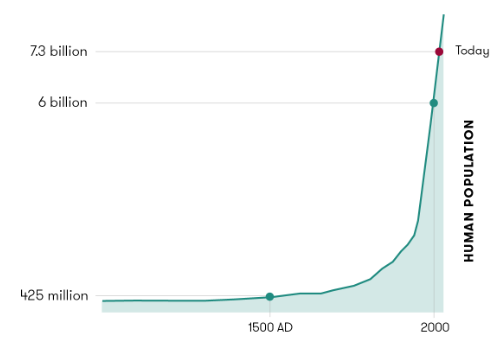
  • Increase In Population: The rapid increase in Population has also demanded a rise in resources such as energy, food, water and many more which speed up greenhouse gas emission from all production processes. Didn't get it not a problem..have a look. Earth's current population is about 7.3 to 7.5 Billion which means there are more than 7 billion bodies to be fed, clothed, kept warm at the same time this needs a bulk amount of resources which eventually results in huge amounts of waste. According to the United Nations report, the world population will b 9.0 Billion by the end of the year 2050 and these numbers will continue to grow. The impact of humans growth on the environment takes two major forms: 
  1. consumption of resources such as food, land, water, air, fossil fuels and minerals.
  2. waste products as a result of consumption such as air and water, pollutant, toxic materials and green house gasses.
Report Source: Our World in Data. 
We as human beings have gone too far but if we didn't think at this moment we will be in trouble in future.

Urbanization

Human beings have become an increasingly powerful environmental force over the last 10,000 years. With the advent of agriculture 8,000 year...